Related links
Puzzle solved as maize pest reveals its Achilles heel
23 March 2012
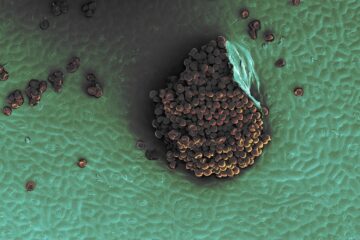
European corn borer larvae in a head of maize.
© Eric Burkness, University of Minnesota
Scientists at Rothamsted Research have identified the crucial controls of population cycles of the European corn borer pest, which could help prevent damage to maize crops and thereby save billions of dollars.
In a study published in the prestigious journal Ecology Letters, Dr James Bell and Dr Alice Milne of Rothamsted Research, working in collaboration with America colleagues, led by Dr Bill Hutchison at the University of Minnesota, mathematically analysed nearly 50 years' data to detect cycles of the corn borer larvae.
Dr Milne said "Identifying population cycles in this pest will help us understand what to expect from this pest which has colonised the UK in 2010".
The European corn borer moth (Ostrinia nubilalis) is a pest whose larvae tunnel into maize crops and cause serious damage. Outbreaks in the United States have cost the American economy 1 billion dollars per annum. In North America across the US Corn Belt and much of southern Canada, the moth is naturally controlled by a disease that infects the larvae. The disease produces wave-like cycles in the population that last between 5 and 7 years.
Borer larvae overwintering in a maize stalk.
© Eric Burkness, University of Minnesota
In the mid-1990s, GM maize was introduced to control the pest further. An analysis of nearly 50 years data on the larval population of the European corn borer has shown that GM crops substantially reduced numbers when applied over a landscape and in large enough proportions. All other cycle collapses (mammals mostly) have been attributed to climate change as far as we know and we believe this is the first demonstration that host plant modification is a successful strategy to controlling pests, which need not be via GM and instead could be through breeding by making the plant less palatable to the pest.
The team is now developing a more detailed model that Dr Bell stated "will help farmers trying to produce maize for future UK demands. GM maize is not permitted in the UK, but there are other lessons we can learn from this study, particularly how manipulating the spatial distribution of the crop in the landscape can influence the population of the moth".
ENDS
Notes to editors
Publication: Putting the brakes on a cycle: bottom-up effects damp cycle amplitude (10.1111/j.1461-0248.2011.01739.x) http://dx.doi.org/10.1111/j.1461-0248.2011.01739.x
About Rothamsted Research
Rothamsted Research, the longest running agricultural research station in the world, providing cutting-edge science and innovation for around 170 years. It receives strategic funding from BBSRC to deliver the knowledge and new practices to increase crop productivity and quality and to develop environmentally sustainable solutions for food and energy production.
About BBSRC
BBSRC invests in world-class bioscience research and training on behalf of the UK public. Our aim is to further scientific knowledge, to promote economic growth, wealth and job creation and to improve quality of life in the UK and beyond.
Funded by Government, and with an annual budget of around £445M, we support research and training in universities and strategically funded institutes. BBSRC research and the people we fund are helping society to meet major challenges, including food security, green energy and healthier, longer lives. Our investments underpin important UK economic sectors, such as farming, food, industrial biotechnology and pharmaceuticals.
For more information about BBSRC, our science and our impact see:
www.bbsrc.ac.uk.
For more information about BBSRC strategically funded institutes see:
www.bbsrc.ac.uk/institutes.
External contact
James Bell, Plant and Invertebrate Ecology Department, Rothamsted Research
james.bell@rothamsted.ac.uk
tel: 01582 763133 ext 2313
Alice Milne, Biomathematics and Bioinformatics Department, Rothamsted Research
alice.milne@rothamsted.ac.uk
tel: 01582 763133 ext 2380
Bill Hutchison, Deptartment of Entomology, University of Minnesota
alice.milne@rothamsted.ac.uk
tel: (612) 624-3278
fax: (612) 625-5299
Darren Hughes, Head of Communications, Rothamsted Research
darren.hughes@rothamsted.ac.uk
tel: 01582 763133 ext 2673
Contact
Rob Dawson, Head of News
rob.dawson@bbsrc.ac.uk
tel: 01793 413204
Chris Melvin, Media Officer
chris.melvin@bbsrc.ac.uk
tel: 01793 414694
fax: 01793 413382
Tracey Jewitt, Media Officer
tracey.jewitt@bbsrc.ac.uk
tel: 01793 413355
fax: 01793 413382