Discovery opens the door to electricity from microbes
24 May 2011
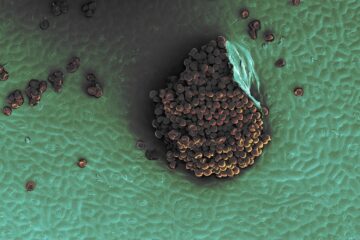
Protein crystals were used to solve the structure of an iron-containing protein on the bacterial surface. This structure helps to explain how a chain of iron atoms bound by proteins forms a 'wire' that allows electricity from the inside of the cell to reach the bacterium surface. Copyright: University of East Anglia
Using bacteria to generate energy is a significant step closer following a breakthrough discovery by BBSRC-funded scientists at the University of East Anglia (UEA).
Published today by the leading scientific journal Proceedings of the National Academy of Sciences (PNAS), the research demonstrates for the first time the exact molecular structure of the proteins which enable bacterial cells to transfer electrical charge.
The discovery means scientists can now start developing ways to 'tether' bacteria directly to electrodes - creating efficient microbial fuel cells or 'bio-batteries'. The advance could also hasten the development of microbe-based agents that can clean up oil or uranium pollution, and fuel cells powered by human or animal waste.
"This is an exciting advance in our understanding of how some bacterial species move electrons from the inside to the outside of a cell," said Dr Tom Clarke of UEA's School of Biological Sciences.
"Identifying the precise molecular structure of the key proteins involved in this process is a crucial step towards tapping into microbes as a viable future source of electricity."
Protein crystals were used to solve the structure of an iron-containing protein on the bacterial surface. This structure helps to explain how a chain of iron atoms bound by proteins forms a 'wire' that allows electricity from the inside of the cell to reach the bacterium surface. Copyright: University of East Anglia
Funded by the Biotechnology and Biological Sciences Research Council (BBSRC) and the US Department of Energy, the project is led by Dr Clarke, Prof David Richardson and Prof Julea Butt of UEA, in collaboration with colleagues at the Pacific Northwest National Laboratory in the US.
In earlier research published by PNAS in 2009, the team demonstrated the mechanism by which bacteria survive in oxygen-free environments by constructing electrical wires that extend through the cell wall and make contact with a mineral - a process called iron respiration or 'breathing rocks'. (See www.uea.ac.uk/bio/news/rocknews)
In this latest research, the scientists used a technique called x-ray crystallography to reveal the molecular structure of the proteins attached to the surface of a Shewanella oneidensis cell through which electrons are transferred.
'Structure of a bacterial cell surface deca-heme electron conduit' by T Clarke (UEA), M Edwards (UEA), A Gates (UEA), A Hall (UEA), G White (UEA), J Bradley (UEA), C Reardon (PNNL), L Shi (PNNL), A Beliaev (PNNL), M Marshall (PNNL), Z Wang (PNNL), N Watmough (UEA), J Fredrickson (PNNL), J Zachara (PNNL), J Butt (UEA) and D Richardson (UEA) is published in the online Early Edition of the Proceedings of the National Academy of Sciences on May 23 2011.
ENDS
Notes to editors
- For further information or to arrange pictures or interviews, please contact Simon Dunford at the University of East Anglia Communications Office (see external contact below)
- The paper is available as a PDF on request
- A jpeg illustrating the discovery is available on request. Picture caption: 'Protein crystals were used to solve the structure of an iron-containing protein on the bacterial surface. This structure helps to explain how a chain of iron atoms bound by proteins forms a 'wire' that allows electricity from the inside of the cell to reach the bacterium surface.'
External contact
Simon Dunford, University of East Anglia Communications Office
s.dunford@uea.ac.uk
tel: 01603 592203
About BBSRC
BBSRC is the UK funding agency for research in the life sciences. Sponsored by Government, BBSRC annually invests around £470M in a wide range of research that makes a significant contribution to the quality of life in the UK and beyond and supports a number of important industrial stakeholders, including the agriculture, food, chemical, healthcare and pharmaceutical sectors.
BBSRC provides institute strategic research grants to the following:
- The Babraham Institute
- Institute for Animal Health
- Institute of Biological, Environmental and Rural Sciences (Aberystwyth University)
- Institute of Food Research
- John Innes Centre
- The Genome Analysis Centre
- The Roslin Institute (University of Edinburgh)
- Rothamsted Research
The Institutes conduct long-term, mission-oriented research using specialist facilities. They have strong interactions with industry, Government departments and other end-users of their research.
Contact
Rob Dawson, Head of News
rob.dawson@bbsrc.ac.uk
tel: 01793 413204
Chris Melvin, Media Officer
chris.melvin@bbsrc.ac.uk
tel: 01793 414694
fax: 01793 413382
Tracey Jewitt, Media Officer
tracey.jewitt@bbsrc.ac.uk
tel: 01793 413355
fax: 01793 413382